


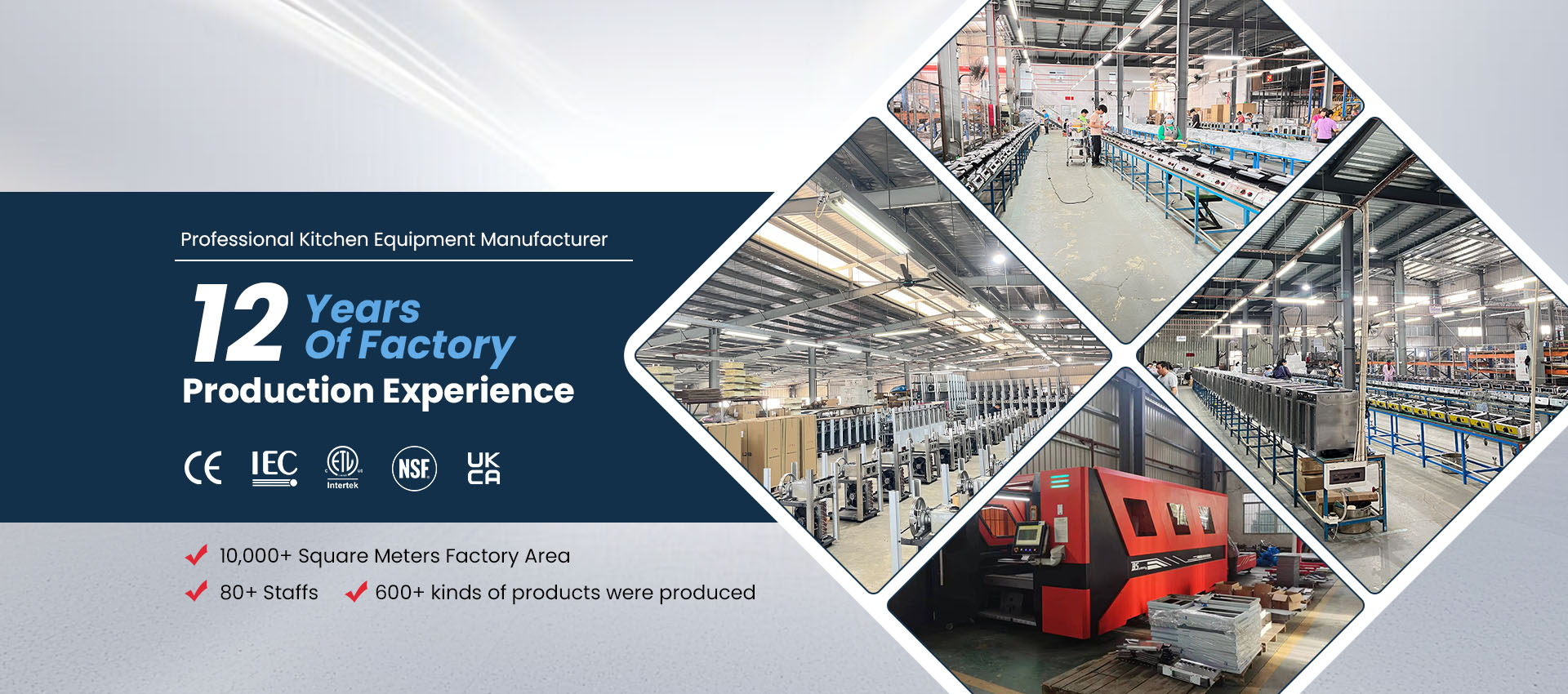
The production of commercial Gas Griddles relies heavily on metal fabrication processes. Because these appliances must withstand high temperatures, heavy daily use, and commercial kitchen environments, precision fabrication and structural stability are essential. Manufacturers typically use a series of sheet metal processing and assembly techniques to transform raw steel into durable cooking equipment.
Sheet Metal Cutting
The first fabrication step is cutting raw stainless steel or carbon steel sheets into the required component sizes. Laser cutting or CNC cutting machines are commonly used to achieve accurate dimensions and smooth edges. Precise cutting ensures that structural parts such as the outer housing, internal supports, and control panels fit correctly during assembly.
CNC Punching
CNC punching machines are used to create holes and openings in the metal sheets. These openings are required for components such as control knobs, burners, gas valves, ventilation slots, and mounting points. Computer-controlled punching improves production accuracy and allows manufacturers to maintain consistent part dimensions across large production batches.
Metal Bending
After cutting and punching, the metal parts are shaped using bending machines. Bending forms the structure of the equipment, including side panels, support frames, and internal brackets. Accurate bending ensures that all components align correctly when the equipment is assembled.
Welding
Welding is a key fabrication process used to join structural parts together. Skilled technicians weld frames, brackets, and internal supports to create a rigid body structure for the gas griddle. Strong welding joints are essential because the equipment must maintain stability under high heat and frequent use.
Grinding And Surface Finishing
Once welding is completed, grinding and polishing processes are applied to the welded areas. These finishing steps smooth the surfaces, remove sharp edges, and improve the visual appearance of the equipment. Surface finishing also prepares stainless steel surfaces for easier cleaning in commercial kitchen environments.
Griddle Plate Machining
The griddle plate itself is a critical component that requires precise machining or surface processing. The plate must be flat and thick enough to distribute heat evenly across the cooking area. Proper machining helps ensure consistent cooking performance and durability during long operating periods.
Component Installation
After fabrication of the structural parts is complete, the equipment moves to the assembly stage. Burners, gas control valves, ignition systems, and cooking plates are installed onto the fabricated body structure. Proper alignment of these components is necessary to maintain stable heat output and efficient gas flow.
Final Assembly And Inspection
The last stage of fabrication involves final assembly and inspection. All components are checked to ensure correct installation and structural integrity. After inspection, the gas griddle is prepared for functional testing and packaging.
Through these fabrication processes, manufacturers transform raw metal materials into reliable commercial cooking equipment. A supplier with complete fabrication capability can maintain better production consistency and ensure the structural durability required for professional kitchen applications.