


What Labeling And Safety Markings Are Mandatory for Gas Appliance Export?
For commercial gas appliance export, labeling is not a small packaging detail. It is part of product compliance, customs clearance, market access, and after-sales traceability. In the EU, gas appliances fall under Regulation EU 2016/426, which became fully applicable on April 21, 2018. The regulation requires conformity assessment before the product is placed on the market, and it also requires the appliance to carry the right identification and compliance marking. For commercial food equipment projects, buyers may also review sanitation-related markings and material declarations as part of the sourcing decision.
CE marking is the core mandatory mark for the EU market
For gas appliances entering the EU market, the CE mark is the essential compliance marking. According to official guidance, manufacturers must draw up the EU Declaration of Conformity, complete the applicable conformity assessment procedure, and affix the CE marking visibly, legibly, and indelibly to the appliance or its data plate. If the nature of the appliance does not allow this, the mark may be placed on the packaging and accompanying documents. This means export market compliance starts at the design and approval stage, not at the shipping stage.
Product identification details are also mandatory
A gas appliance exported to the EU must not carry only a CE symbol. Official guidance also states that the appliance must bear a type, batch, or serial number, together with the manufacturer’s name, registered trade name or trademark, and postal address. Where the size or nature of the product does not allow all of this on the appliance itself, the information may be moved to the packaging or an accompanying document. For project sourcing, this traceability is critical because it connects every shipped unit to technical files, inspection records, and any future corrective action.
Instructions and safety information are part of the mandatory labeling package
For gas appliances, mandatory marking is broader than the metal rating plate. The EU guidance states that the manufacturer must ensure the appliance is accompanied by instructions and safety information in a language that is clear, legible, and easily understood in the destination market. This is especially important for commercial kitchen equipment, where installation conditions, gas type, adjustment procedures, and operating warnings directly affect safety. A shipment with correct hardware but incomplete manuals can still create compliance problems at import or installation.
Importer and responsible operator details may also be required
When gas appliances are placed on the EU market, a responsible economic operator based in the EU or Northern Ireland must carry out certain compliance tasks, and the guidance states that the relevant contact details must be indicated on the product, packaging, parcel, or an accompanying document. Importers must also indicate their name, registered trade name or trademark, and postal address when they place products on the market. This is one reason manufacturer vs trader matters so much. A real manufacturer usually has a clearer compliance chain, while a trading route can complicate responsibility for labels, declarations, and technical files.
US projects focus more on recognized certification marks and equipment labels
The United States does not use CE marking for gas appliances. Instead, market access and buyer acceptance often depend on certification by a Nationally Recognized Testing Laboratory. OSHA materials list ANSI Z83.11 for gas food service equipment, which shows the certification path commonly connected with commercial gas cooking equipment. In practice, buyers often look for a recognized certification mark from an accepted testing body, along with the rating and identification information required by the applicable standard and project specification. For foodservice installations, sanitation review can also matter, especially where local inspectors or chain buyers require it.
Sanitation and material markings influence food equipment acceptance
For commercial griddles and other kitchen appliances, safety marking alone is not always enough. NSF states that NSF/ANSI 4 covers commercial cooking equipment, including griddles, and sets requirements for materials, design, construction, and performance. NSF also identifies NSF/ANSI 51 as the standard for food equipment materials and finishes. This means material standards used for food-contact zones, grease areas, and cleanable surfaces often affect documentation, surface labeling logic, and project approval. In bulk supply considerations, these details can influence whether a model is accepted smoothly or delayed for additional review.
What should appear on a compliant export label
| Market | Marking or labeling focus | Typical mandatory or expected items |
|---|---|---|
| EU | Legal compliance marking | CE mark, product type, batch or serial number, manufacturer name, trademark, postal address |
| EU | Accompanying information | Instructions, safety information, declaration support, importer or responsible operator details when applicable |
| US | Project and certification acceptance | Recognized NRTL certification mark where required, product identification label, gas rating data, installation and warning information |
| Foodservice projects | Hygiene and material review | Sanitation certification evidence, food-contact material information, traceable product identification |
The exact label layout depends on the appliance structure and destination market, but the common rule is clear traceability plus clear safety communication.
Why Dingfeng is better positioned for compliant labeling control
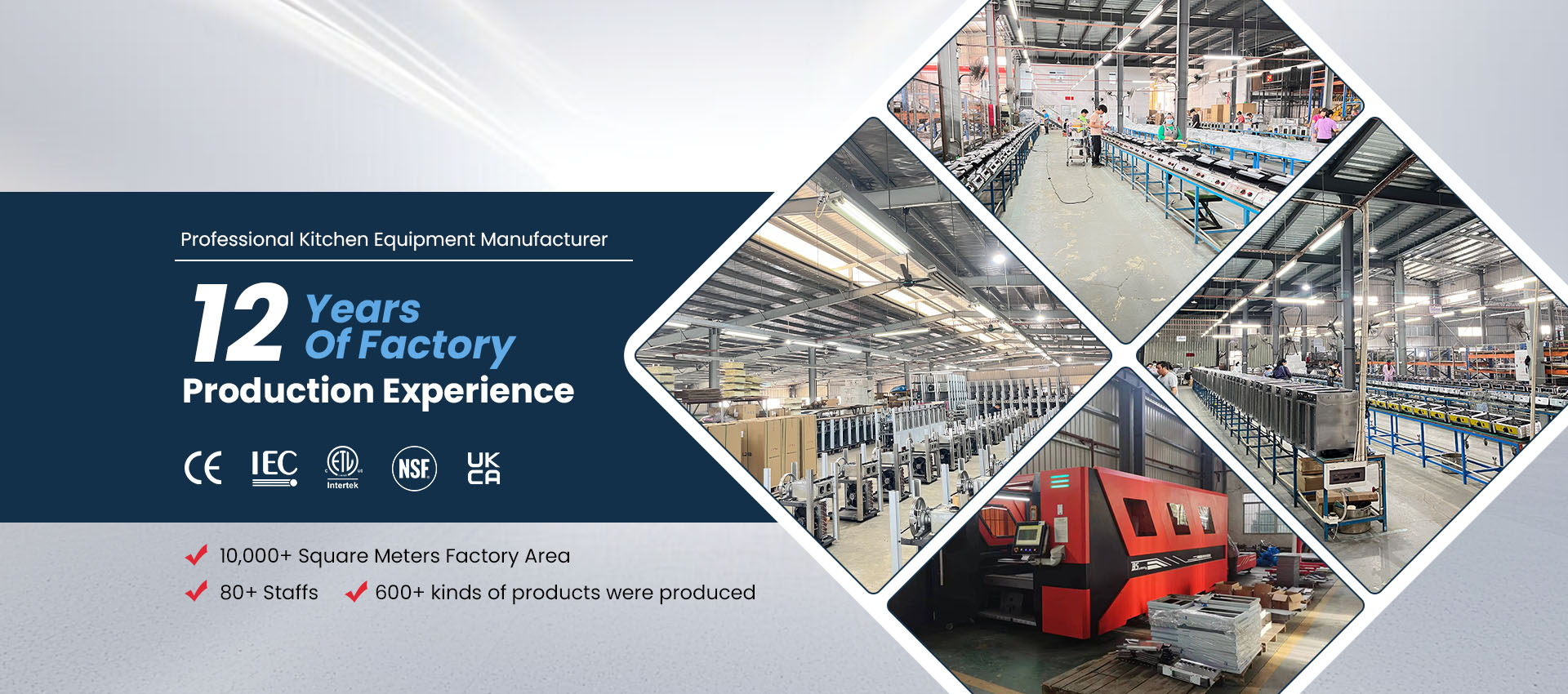
Dingfeng presents itself as a factory-based commercial kitchen equipment manufacturer with a production facility of over 10,000 square meters, more than 80 trained employees, and more than 1000 product types produced since establishment. Its site also shows Gas Griddles within its commercial kitchen range and highlights advanced CNC punching, cutting, bending, and welding equipment, along with multiple quality inspection processes. That manufacturing base matters because compliant export labeling is not only a design task. It must stay aligned with the OEM / ODM process, manufacturing process overview, rating plate data, carton marks, manuals, and final inspection records.
A practical checklist before shipping
Before shipping a gas appliance internationally, the supplier should confirm five points. First, the destination market must be defined clearly. Second, the compliance mark must match that market. Third, the rating plate data must match the approved configuration. Fourth, instructions and safety warnings must match the destination language and gas conditions. Fifth, the final inspection should verify that every unit, carton, and document set carries the same traceable information. These quality control checkpoints reduce relabeling cost, customs delays, and installation risk.
For export gas appliances, labeling is not a finishing touch added at the end of production. It is part of the compliance system from design to shipment. The supplier that controls manufacturing, documentation, and marking in one workflow is usually the supplier that delivers more stable export performance across regulated markets.