


Commercial Fryer vs Commercial Deep Fryer: Which Better Supports Heavy Duty Operations?
Commercial deep fryers usually provide stronger capacity and continuous frying performance for heavy-duty operations, while standard commercial fryers offer flexibility for general restaurant use.
What Is the Difference Between a Commercial Fryer and a Commercial Deep Fryer?
Commercial fryers and commercial deep fryers are both designed for professional food businesses, but their structures and operating capabilities can differ.
In many markets, “commercial fryer” refers to a broad category of professional frying equipment, while “commercial deep fryer” emphasizes equipment designed for deeper oil capacity and continuous frying tasks.
| Comparison Factor | Commercial Fryer | Commercial Deep Fryer |
|---|---|---|
| Oil Capacity | Medium to large depending on model | Usually larger capacity design |
| Cooking Volume | General commercial use | Heavy-duty continuous frying |
| Application | Restaurants, cafes, food shops | Fast food chains, high-output kitchens |
| Production Demand | Medium volume | High volume |
| Operation Focus | Flexible frying | Long-time intensive frying |
The right choice depends on menu requirements, daily production volume, and business scale.
Why Do Restaurants Choose Commercial Fryers?
Commercial fryers are widely used because they provide efficient frying performance for many food businesses.
Their advantages include:
Flexible capacity options
Suitable for different food categories
Easier operation
Lower investment for smaller businesses
They are suitable for:
Small restaurants
Cafes
Snack shops
Convenience stores
For businesses with moderate frying demand, commercial fryers provide a practical balance between performance and cost.
Why Do Heavy-Duty Kitchens Choose Commercial Deep Fryers?
Commercial deep fryers are designed for businesses requiring higher frying capacity and longer operating hours.
Their advantages include:
Larger oil capacity
Higher production efficiency
Better support for continuous frying
Reduced waiting time during peak periods
They are commonly used in:
Fast-food chains
Fried chicken restaurants
Catering businesses
Large commercial kitchens
For high-volume operations, deep fryers help maintain stable output throughout busy service periods.
Which Equipment Provides Better Frying Efficiency?
Frying efficiency depends on production requirements.
Commercial fryers provide advantages for:
Flexible menu preparation
Medium-volume frying
Smaller kitchen operations
Commercial deep fryers provide advantages for:
Large batch cooking
Continuous food production
Peak-hour demand
For restaurants selling large quantities of fried products, deep fryers usually provide better operational efficiency.
Which Fryer Handles Heavy-Duty Operations Better?
Heavy-duty operations require equipment that can maintain stable performance over long working periods.
Commercial deep fryers are generally better suited because they provide:
Larger oil volume
Stronger heat recovery
Higher cooking capacity
Longer continuous operation ability
Commercial fryers may still perform well for businesses with lower production requirements.
How Does Oil Capacity Affect Frying Performance?
Oil capacity directly affects cooking efficiency and product consistency.
Larger oil capacity provides:
Better temperature stability
Faster recovery after adding food
More consistent frying results
Commercial deep fryers often have larger tanks, making them suitable for high-frequency frying.
Smaller commercial fryers can be more efficient for businesses that do not require continuous large-volume production.
Which Equipment Provides Better Temperature Stability?
Temperature stability is essential for maintaining food quality.
Important factors include:
Heating power
Oil capacity
Temperature control system
Tank design
Commercial deep fryers often provide better stability during heavy use because larger oil volume changes temperature more slowly.
Commercial fryers can provide excellent control when matched with appropriate production requirements.
Which Equipment Is More Cost Effective?
Cost effectiveness depends on business scale.
Commercial fryers may be more suitable because:
Lower initial investment
Suitable for smaller operations
Flexible product selection
Commercial deep fryers may provide better long-term value because:
Higher production efficiency
Reduced cooking delays
Better support for business growth
The best choice depends on whether the equipment capacity matches actual demand.
Which Fryer Is Easier to Maintain?
Maintenance affects equipment lifespan and operating costs.
Both types require:
Regular oil replacement
Tank cleaning
Heating system inspection
Component checking
Commercial fryers may be easier to manage because of their smaller structure.
Commercial deep fryers require more maintenance attention due to:
Larger oil volume
Higher usage frequency
More intensive operation
Professional equipment design helps simplify cleaning and maintenance.
Which Fryer Is Better for Different Food Businesses?
Different businesses have different requirements.
| Business Type | Recommended Equipment |
|---|---|
| Small Cafe | Commercial Fryer |
| Snack Shop | Commercial Fryer |
| Fried Chicken Chain | Commercial Deep Fryer |
| Fast Food Restaurant | Commercial Deep Fryer |
| Catering Business | Commercial Deep Fryer |
| Hotel Kitchen | Depends on Production Needs |
Selecting equipment based on actual workload helps avoid unnecessary investment.
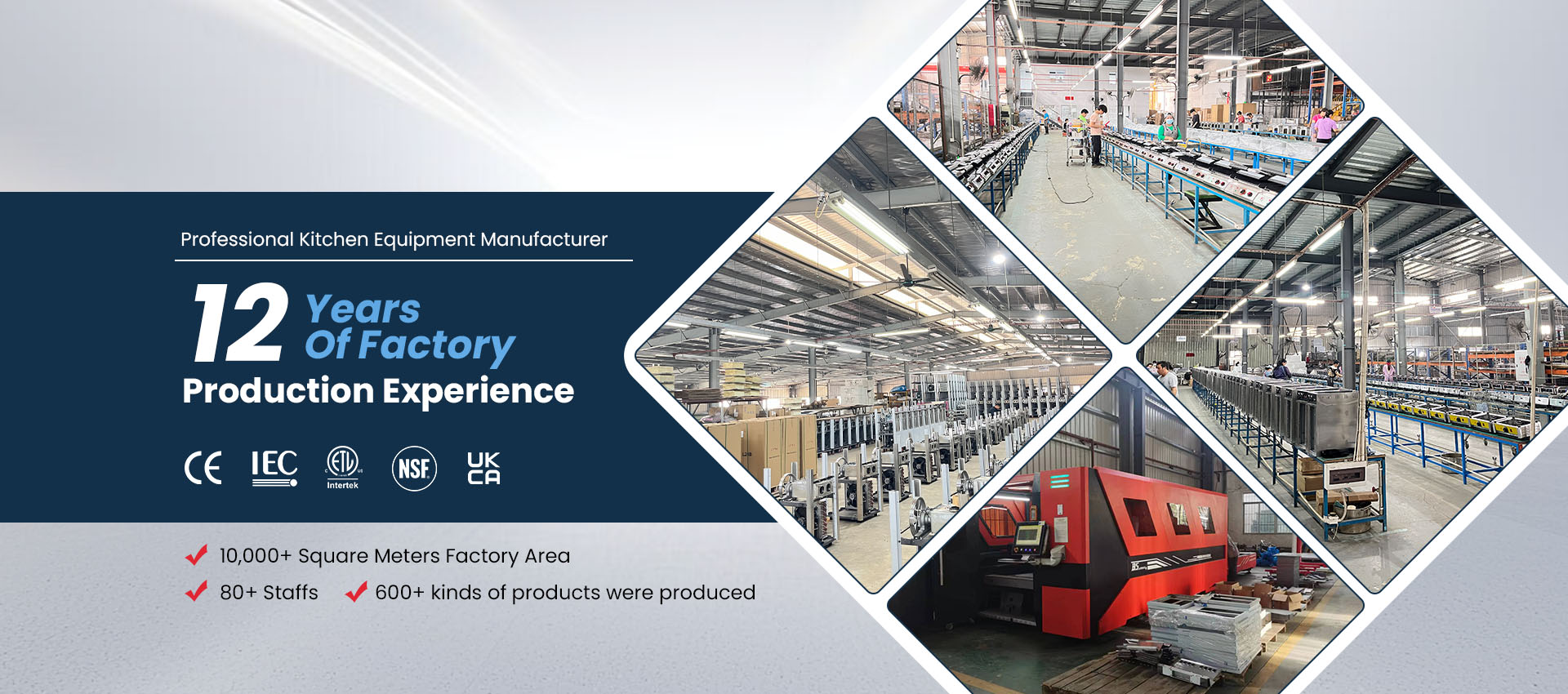
How Does Manufacturing Quality Affect Fryer Durability?
Equipment structure and manufacturing quality directly influence long-term performance.
Professional fryer production focuses on:
Stainless Steel Construction
High-quality stainless steel improves corrosion resistance and durability.
Heating System Design
Efficient heating improves recovery speed and energy utilization.
Oil Tank Structure
Well-designed tanks improve cleaning and frying consistency.
Temperature Control
Reliable control systems maintain stable cooking conditions.
Safety Testing
Performance inspections ensure equipment reliability before shipment.
For international buyers, choosing an experienced manufacturer reduces operational risks.
How Do Manufacturers Test Commercial Fryer Performance?
Quality testing usually includes:
Heating Performance Testing
Checking heat-up speed and temperature stability.
Continuous Operation Testing
Evaluating performance during extended use.
Safety Inspection
Checking electrical, gas, and operational safety.
Structure Inspection
Ensuring welding quality and equipment strength.
Final Performance Check
Confirming equipment meets commercial kitchen requirements.
These processes help ensure stable performance in global markets.
Should Businesses Choose a Commercial Fryer or Commercial Deep Fryer?
The decision depends on production needs.
Choose a commercial fryer when the business needs:
Flexible capacity
Moderate frying volume
Lower investment
Choose a commercial deep fryer when the business needs:
High production capacity
Continuous operation
Heavy-duty performance
The right equipment should match current demand while supporting future business growth.
Commercial Fryer vs Commercial Deep Fryer: Which Better Supports Heavy Duty Operations?
Commercial deep fryers generally provide stronger support for heavy-duty operations because of larger capacity, better temperature stability, and continuous frying capability.
Commercial fryers are more suitable for businesses requiring flexible operation and moderate production volume.
For restaurants and food businesses, the best choice depends on menu demand, daily output, kitchen space, and long-term operating plans.
Conclusion: Commercial Fryer vs Commercial Deep Fryer: Which Better Supports Heavy Duty Operations?
Both commercial fryers and commercial deep fryers play important roles in professional kitchens.
Commercial fryers provide flexibility and efficiency for general food businesses, while commercial deep fryers deliver stronger performance for high-volume frying operations.
Selecting the right equipment requires balancing production needs, equipment capacity, operating costs, and future expansion goals.