


What Certifications Are Required To Export Gas Griddles To The Eu Or Us?
Exporting a commercial Gas Griddle to the EU or US is not only about burner output, plate thickness, or price. The first gate is compliance. For the EU market, gas appliances fall under the Gas Appliances Regulation and must carry CE marking after the correct conformity assessment, technical file preparation, and EU Declaration of Conformity are completed. The European Commission notes that this framework has applied since April 21, 2018, and the manufacturer is responsible for identifying all applicable rules before placing the product on the market.
EU requirements start with CE under the Gas Appliances Regulation
For a gas griddle sold into the EU, the core compliance path is Regulation EU 2016/426 for appliances burning gaseous fuels. In practice, this means the appliance must be assessed against the essential requirements of the regulation, supported by technical documentation, and marked correctly. The European Commission also publishes harmonised standards under this regulation, which manufacturers use to show presumption of conformity.
If the gas griddle includes electrical ignition, digital controls, lighting, or other electronic modules, additional EU directives may apply. The EMC Directive covers electromagnetic compatibility, while the Low Voltage Directive applies when the product operates within the stated voltage range of 50 to 1000 V AC or 75 to 1500 V DC. That is why an export market compliance review must cover the full machine, not only the burner section.
Food contact and material standards matter in both markets
A commercial griddle is a heat appliance, but it is also food equipment. In the EU, food contact materials must comply with Regulation EC No 1935/2004, and manufacturing control is further supported by Regulation EC No 2023/2006 on good manufacturing practice. For stainless steel structures, splash zones, grease trays, and food-contact surfaces, this makes material traceability and fabrication consistency part of the project sourcing checklist.
For the US market, buyers and inspectors commonly look for sanitation certification to NSF standards. FDA’s own list of American National Standards for Food Equipment includes NSF/ANSI 4 for commercial cooking equipment, and NSF states this standard covers materials, design, construction, and performance for commercial cooking equipment.
The US market usually requires recognized third party certification
The US does not use CE marking for commercial gas griddles. Instead, market acceptance usually depends on recognized third party certification. Gas food service equipment is covered by CSA and ANSI standard Z83.11 and CSA 1.8. OSHA also maintains the Nationally Recognized Testing Laboratory system and lists the standards and laboratories used for workplace product approval. For models with electrical parts, buyers may also ask for NRTL listing tied to the relevant electrical safety standard.
Sanitation is another key point in bulk supply considerations. A gas griddle that passes gas safety but lacks accepted hygiene certification can still face delays in restaurant chains, dealer networks, school projects, and municipal inspections. In many US purchasing situations, ANSI gas safety certification and NSF sanitation certification are reviewed together.
| Market | Main compliance focus | Common documents |
|---|---|---|
| EU | GAR compliance and CE marking | Technical file, test reports, EU Declaration of Conformity, product marking |
| EU with electrical modules | EMC and sometimes LVD | EMC evidence, electrical safety file, updated declaration |
| US | Gas safety certification | ANSI Z83.11 and CSA 1.8 based certification |
| US food service projects | Sanitation approval | NSF/ANSI 4 certification or equivalent accepted by buyer |
Manufacturer vs trader makes a real difference
When export buyers compare a manufacturer vs trader, the biggest difference is document control. A true factory can normally provide material records, welding process consistency, component traceability, test plans, and revision history. That is especially important for OEM / ODM process work, where gas category, regulator configuration, ignition layout, plate material, and label language may change by market. A trader may quote fast, but compliance ownership becomes harder when drawings, certifications, and production change records sit in different hands.
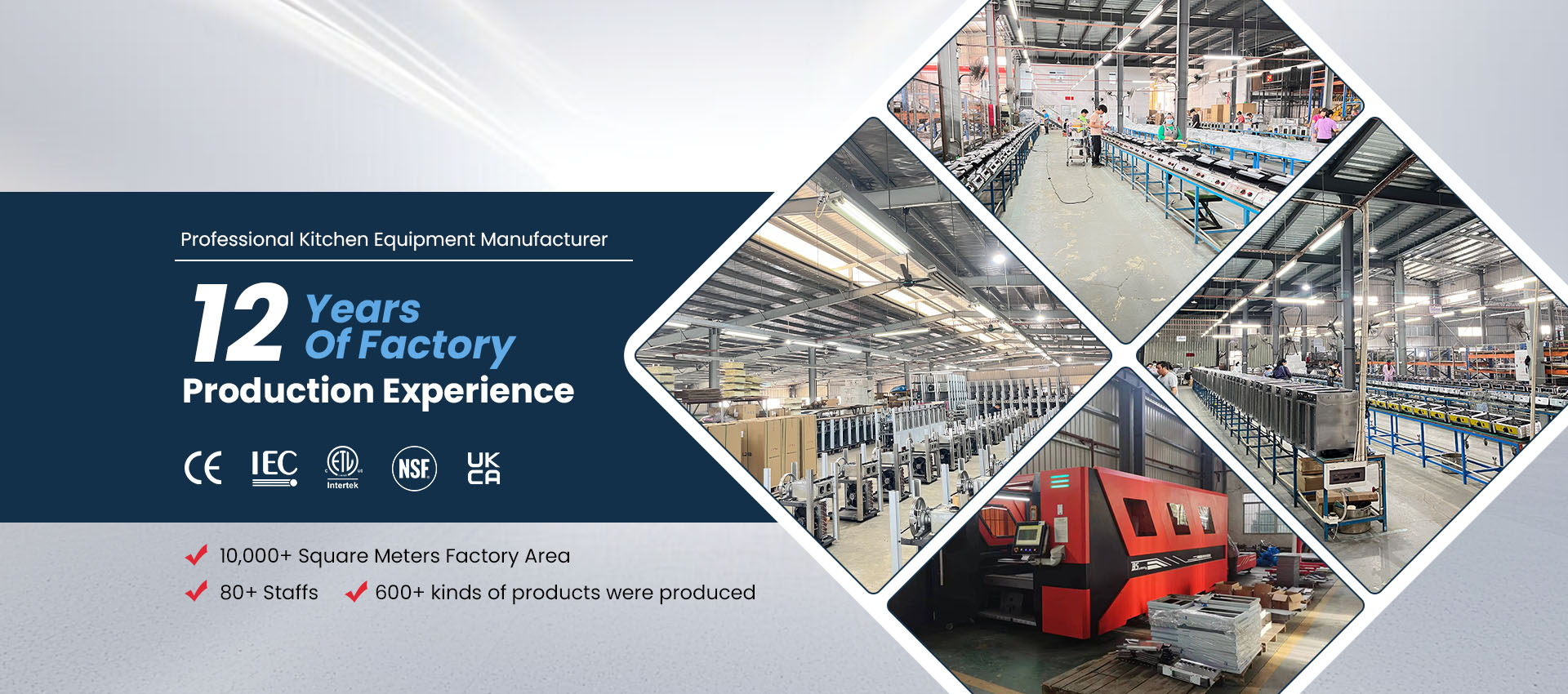
Dingfeng positions itself as a manufacturer with an independent factory and mature production lines. Its site states that Jiangmen Dingfeng Saving Kitchen Electric Co., Ltd. operates a factory of more than 10,000 square meters, has more than 80 trained employees, has produced more than 1000 product types, and uses CNC punching, cutting, bending, and welding equipment. It also offers multiple gas griddle models within its commercial kitchen range. That factory base is valuable for export projects that need repeatable quality control checkpoints and stable documentation across bulk orders.
What buyers should check before placing bulk orders
Before approving a gas griddle supplier, ask for five things. First, confirm the target market and gas type. Second, verify which certifications already exist for the exact model. Third, review material standards used for the griddle plate, body, and grease management parts. Fourth, check the manufacturing process overview, especially cutting, bending, welding, leak testing, and final inspection. Fifth, confirm that labels, manuals, cartons, and serial control can be adapted for OEM programs and repeated at scale.
A strong supplier should be able to connect compliance with production, not treat certification as a separate sales file. That is what reduces rework, customs friction, and project delays. For EU and US exports, the winning gas griddle supplier is the one that can prove safety, sanitation, traceability, and stable mass production on the same document path.