


How Do Ce And Ul Requirements Affect Gas Griddle Design?
Gas Griddle design changes significantly when a product is built for export rather than only for domestic use. For the EU market, the starting point is CE compliance under Regulation EU 2016/426 on appliances burning gaseous fuels. The European Commission states that this regulation became fully applicable on April 21, 2018, and it requires the manufacturer to complete conformity assessment, technical documentation, and product marking before the appliance is placed on the market. For the US market, the path is different. Commercial gas cooking equipment is usually evaluated through a Nationally Recognized Testing Laboratory system to applicable gas equipment standards, and OSHA lists ANSI Z83.11 for gas food service equipment within its NRTL recognition materials. This is why export market compliance affects not only paperwork, but also burner layout, gas train design, labels, structure, testing methods, and quality control checkpoints.
CE compliance changes the full engineering logic
CE for gas griddles is not just a label on the carton. It starts at the design stage. Under the EU Gas Appliances Regulation, manufacturers must prove that the appliance meets essential safety requirements, and harmonised standards can support presumption of conformity. That means the design team must think early about combustion stability, ignition reliability, gas tightness, heat resistance, operating instructions, warning markings, and the technical file. If a gas griddle includes electrical ignition, lighting, or digital controls, the EMC Directive can also become relevant, because the European Commission says it limits electromagnetic emissions and governs immunity to interference. In some cases, the Low Voltage Directive may also apply when the electrical section falls within its voltage range.
For design engineers, this means CE requirements push the product toward documented risk control. Ventilation paths, control knob spacing, flame supervision, ignition distance, surface temperature management, and label content all need to match the final approved configuration. A factory cannot freely swap parts after testing without reviewing the compliance impact again. That is one reason why manufacturer vs trader becomes important in commercial kitchen exports. A real manufacturer can usually connect design drawings, test samples, process revisions, and final production records inside one system, while a trader often depends on multiple upstream parties for the same file set.
US certification affects structure and component selection in a different way
The US approach is more certification-body driven. OSHA’s NRTL materials include ANSI Z83.11 Gas Food Service Equipment, which is used for ranges and unit broilers and is part of the gas food service compliance framework recognized in the US market. In practical sourcing language, many buyers ask whether a machine has UL, ETL, or equivalent recognized certification. The key issue is not the brand name of the mark alone, but whether the appliance has been evaluated by an accepted testing body to the applicable standard.
This affects gas griddle design in several direct ways. Gas valves, regulators, ignition assemblies, hoses, fittings, wiring routes, clearances, and overheat protection must be chosen with certification compatibility in mind. The design also needs stable repeatability for the certified build. A griddle that passes testing with one valve system or one burner arrangement cannot be treated as a free-form platform for unlimited later substitutions. For OEM / ODM process work, this is critical. Cosmetic changes are usually easier to manage than combustion-system changes, because gas path changes may trigger new validation, new drawings, or new certification review.
Food equipment rules also shape materials and cleanability
Gas griddles are heating appliances, but they are also food equipment. In the EU, food contact materials placed on the market must comply with Regulation EC No 1935/2004. The European Commission explains that this regulation sets the general principles of safety and inertness for food contact materials. In the US market, NSF notes that NSF/ANSI 4 establishes minimum food protection and sanitation requirements for commercial cooking equipment. That means export-ready design must also consider material standards used, surface finish, weld quality, grease control, cleanability, and contamination risk reduction.
For a commercial gas griddle, these requirements influence whether stainless steel grades are suitable for the intended zones, whether corners can be cleaned efficiently, whether splash areas resist corrosion, and whether grease trays and food-contact sections support hygienic use. This is why project sourcing checklist reviews should not stop at burner power or plate thickness. Material traceability and sanitation-friendly fabrication are just as important in bulk supply considerations.
Design impact summary by market
| Market focus | Main compliance route | Direct design effect |
|---|---|---|
| EU gas function | CE under Regulation EU 2016/426 | Burner system, gas tightness, warnings, technical file, conformity control |
| EU electrical section | EMC and sometimes LVD | Ignition wiring, control modules, interference resistance, electrical safety layout |
| US gas safety | NRTL evaluation to applicable gas equipment standard such as ANSI Z83.11 | Certified gas train, approved components, stable production configuration |
| US sanitation | NSF/ANSI 4 in many foodservice applications | Stainless steel selection, weld finish, cleanability, grease handling |
Why factory capability matters more than trading ability
When buyers compare a manufacturer vs trader, certification-driven design makes the difference clearer. A trader may provide a quotation quickly, but export compliance depends on controlled drawings, verified materials, leak testing, inspection records, and production consistency. A manufacturer can usually align engineering, procurement, assembly, and test data in one chain. That reduces the risk of design drift between sample approval and bulk production.
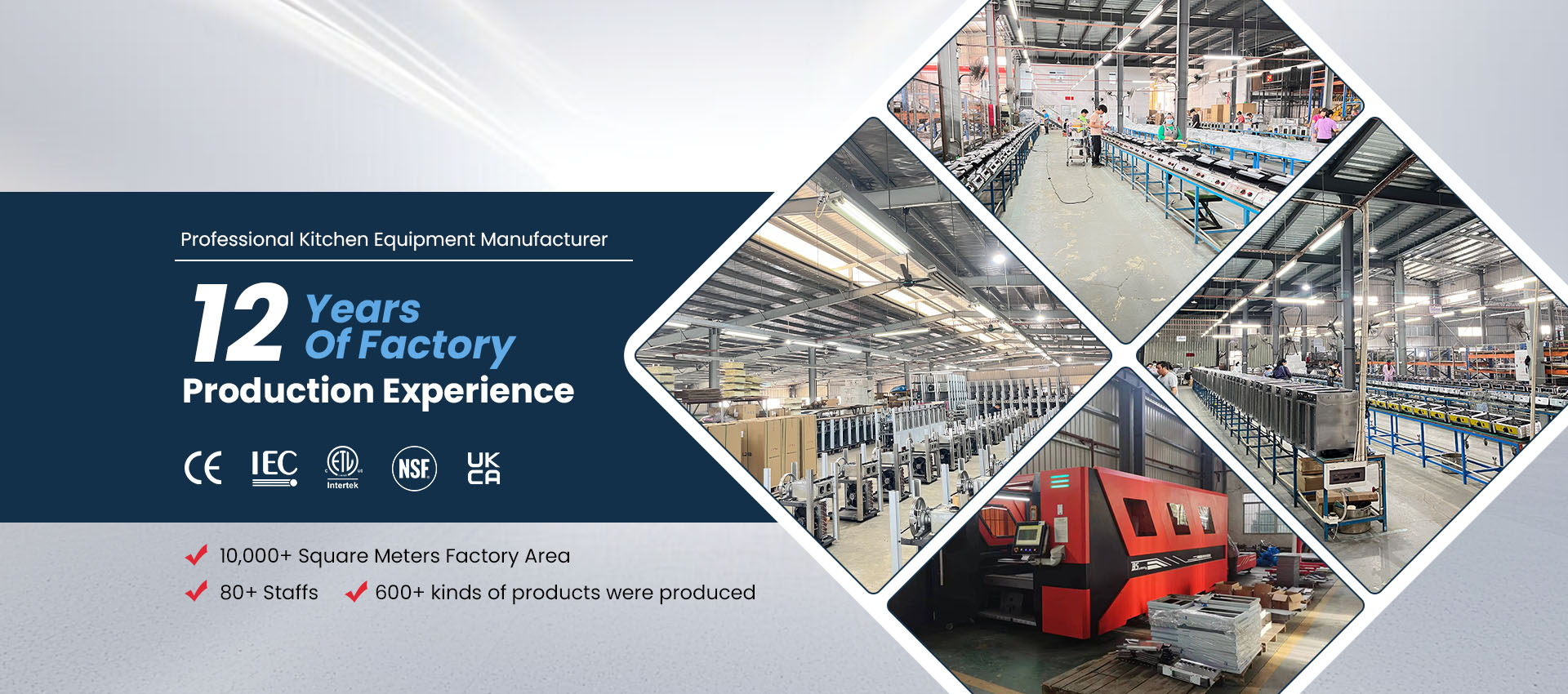
Dingfeng presents itself as a factory-based commercial kitchen equipment manufacturer. Its website states that Jiangmen Dingfeng Saving Kitchen Electric Co., Ltd. has a modern factory covering more than 10,000 square meters, more than 80 well-trained employees, and has produced more than 1000 different product types. Its site also shows gas griddles as part of its product range, and its news content emphasizes factory-based gas griddle quality control and gas leakage testing procedures. For export projects, this kind of in-house structure supports a more reliable OEM / ODM process, because engineering changes, process updates, and final inspections can be tracked inside the same production system.
Manufacturing process overview and control points
Once CE and US certification requirements are included, the manufacturing process overview becomes more disciplined. Raw material receiving must verify the correct stainless steel and component specifications. Cutting, bending, welding, and assembly must follow approved drawings. Gas piping installation must be consistent. Ignition function, flame stability, and leakage checks must be documented. Final labels, rating plates, manuals, and carton marks must match the certified target market version.
Quality control checkpoints therefore become part of compliance, not just part of factory routine. Dingfeng’s own gas griddle content highlights leakage testing and factory-based inspection logic, which fits the needs of export projects where repeated production accuracy matters as much as sample performance.
What buyers should confirm before placing an order
For project sourcing, a practical checklist is simple. Confirm the target market first. Confirm whether the model is designed for CE requirements, US certification requirements, or both. Confirm whether electrical ignition or controls add EMC or electrical obligations. Ask for the compliance file structure, not only a verbal promise. Check material standards used for food-contact and high-heat zones. Review whether the OEM / ODM process allows market-specific label, manual, and gas-type adaptation without breaking certification alignment. Finally, verify that the factory has repeatable testing and inspection records for bulk supply.
CE and UL-related requirements do more than affect approval timing. They shape the gas griddle from the first drawing to the final shipment. A supplier that understands design, certification, and production as one connected system is far better positioned to support stable export orders across the EU and US markets.