


What Should Distributors Consider When Sourcing Waffle Makers
Sourcing Waffle Makers for distribution is not only a product selection task. It is a supply-chain decision that affects repeat orders, warranty risk, market positioning, and long-term margin stability. A strong waffle maker program needs more than an attractive sample. It needs a supplier with stable production, a clear product range, consistent materials, and the ability to support OEM and export requirements without creating variation between batches. Dingfeng’s waffle maker category currently covers 38 products, including Belgian waffle machines, sandwich waffle makers, pancake-related units, novelty-shape models, and multi-grid formats, which makes it easier to build a tiered distribution lineup rather than relying on a single SKU.
Product range should match channel strategy
Distributors should first decide which type of waffle maker fits their customer base. Some markets need restaurant-oriented Belgian waffle machines with deeper grids and stronger output. Others need compact countertop models, novelty formats, or sandwich waffle units that support café and snack-shop sales. Dingfeng’s lineup reflects this kind of segmentation. Its 2 Grids Commercial Belgian Waffles Machine is positioned for high-volume production of thick Belgian waffles, while its Electric Sandwich Waffle Maker can produce four sandwich waffles in one cycle and includes temperature control plus a digital timer. That range gives distributors more flexibility when building catalog layers for entry-level, mid-range, and specialty demand.
Manufacturer vs trader matters more than catalog size
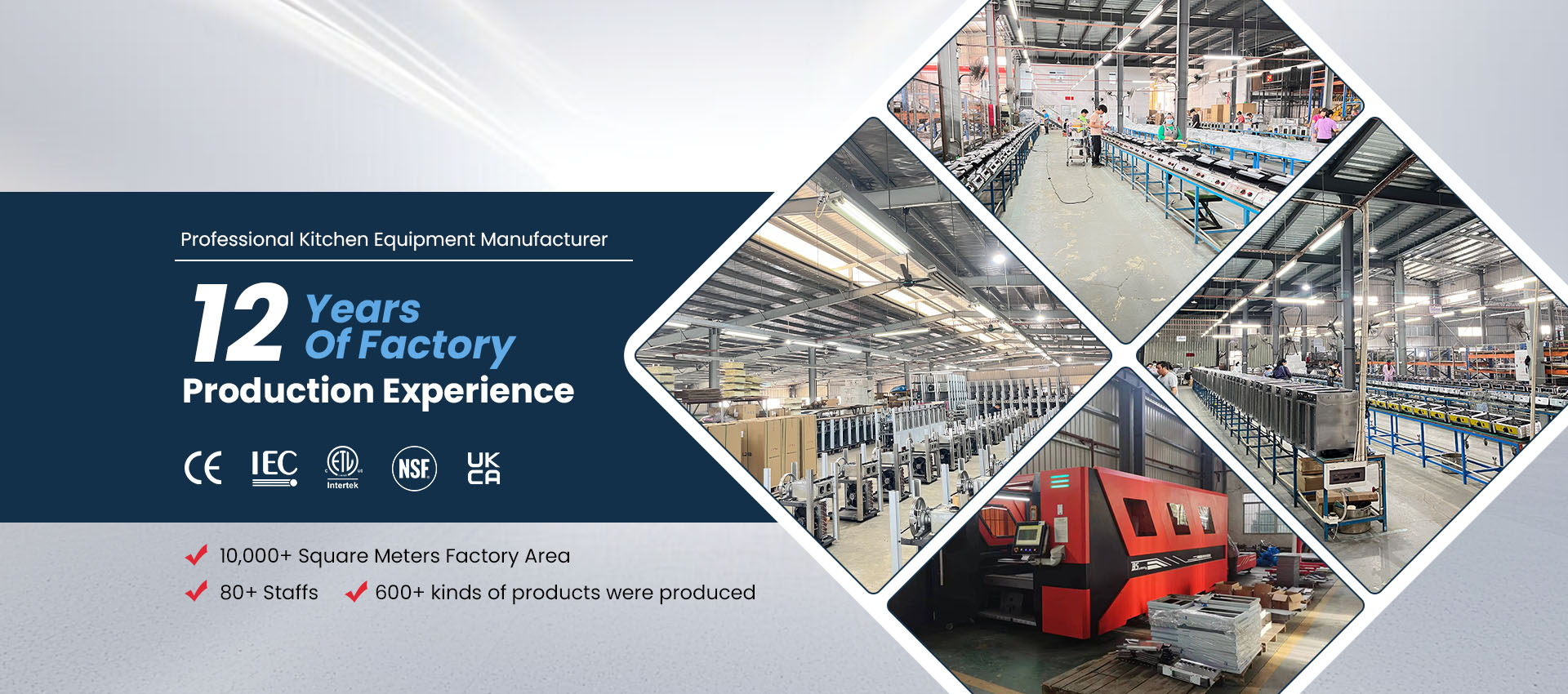
One of the most important sourcing questions is whether the supplier is a real manufacturer or mainly a trading company. A trader may offer a broad catalog, but stable quality is harder to maintain when different models come from different upstream factories. A manufacturer can usually keep tooling, assembly standards, material control, and final inspection inside one system. Dingfeng states that it operates an independently built factory of over 10,000 square meters, has more than 80 trained employees, six mature production lines, and has produced more than 1,000 product types. For distributors, that matters because repeatability across bulk orders is often more valuable than a low first quotation.
Material standards used affect complaint rates and product life
Material selection should be reviewed early because it shapes both performance and after-sales risk. Dingfeng’s Belgian waffle machine uses commercial-grade stainless steel for the housing, precision-cast aluminum plates, and a non-stick Teflon surface. Its sandwich waffle model also uses a temperature-controlled structure aimed at consistent browning and repeated use. More broadly, commercial waffle maker buying references note that cast aluminum is a popular commercial choice because it offers strong heat distribution and durability. For distributors, this means the right question is not only whether the machine looks solid, but whether the plate material, body material, and coating standard are stable across every production lot.
Quality control checkpoints should be visible before the first order
A distributor should never rely only on the finished sample. The better approach is to ask how the supplier controls consistency during production. The manufacturing process overview should include raw material inspection, plate casting or machining checks, coating inspection, heating performance testing, thermostat verification, timer verification, hinge checks, and final packing inspection. Dingfeng’s published product details emphasize adjustable thermostats, power indicator lights, digital timing, heavy-duty hinges, and overflow-control structures on key models. Those features only create real value when they are supported by process control rather than one-time sample tuning.
OEM and ODM process strength affects distributor growth
For many distributors, standard products are only the starting point. Growth often depends on private label development, packaging changes, voltage adaptation, plug changes, and market-specific model selection. This is where the OEM and ODM process becomes important. Dingfeng’s waffle maker range covers multiple structures and usage scenarios, from compact units to larger multi-grid formats, which suggests a broader technical base for customization. A supplier with a real factory and multiple mature production lines is generally better positioned to keep customization under control than a supplier that depends on external factories for each variation.
Bulk supply considerations should go beyond price
A low sample cost does not guarantee a strong distribution program. Bulk supply considerations should include repeat lead time, carton consistency, spare-part continuity, output stability, and the ability to keep the same structure over future orders. Dingfeng’s Belgian waffle unit is clearly described for commercial kitchen use, with 220 to 240V input, 1.6 kW power, dual deep-grid plates, and one-year warranty support. That kind of published parameter structure is useful because it gives distributors a clearer baseline for evaluating batch consistency and market positioning. For scaled sourcing, the real goal is not the cheapest first order. It is the supplier that can ship the same product standard again and again without drift.
Export market compliance should be checked before market launch
For international distribution, export market compliance cannot be treated as a later step. Waffle makers are food-contact appliances, so material safety and documentation matter in addition to electrical and labeling requirements. The European Commission states that all food-contact materials placed on the European market must comply with Regulation EC No 1935/2004, which sets the general principles of safety and inertness. For distributors, this means the sourcing checklist should cover not only product appearance and performance, but also documentation for food-contact surfaces, labeling alignment, destination voltage, and any market-specific instruction requirements.
A practical sourcing checklist for distributors
| Key point | What to review | Why it matters |
|---|---|---|
| Supplier type | Manufacturer or trader | Affects repeatability and process control |
| Product range | Belgian, sandwich, novelty, compact, multi-grid | Supports broader channel coverage |
| Material standards | Stainless steel body, cast aluminum plates, coating consistency | Reduces complaint risk |
| Functional controls | Thermostat, timer, indicator lights, hinge stability | Improves batch consistency |
| OEM ability | Branding, voltage, packaging, plug adaptation | Supports private label growth |
| Compliance readiness | Food-contact documentation and export labeling | Reduces market-entry risk |
| Bulk-order stability | Lead time, packing consistency, repeat specifications | Protects long-term distribution value |
This checklist is more useful than comparing only brochure photos because it connects product choice with resale performance and future order reliability.
Why Dingfeng is a stronger fit for distribution programs
Dingfeng’s value for distributors comes from the combination of range depth and factory control. Its site shows a dedicated waffle maker category with 38 products, a factory base of over 10,000 square meters, more than 80 trained employees, six mature production lines, and a record of producing more than 1,000 product types. Its key waffle machines also show the commercial features distributors usually need to sell confidently, including stainless steel housings, cast aluminum plates, non-stick surfaces, adjustable thermostats, timers, and structures designed for repeated use. That combination gives distributors a more stable foundation for both standard catalog sales and OEM expansion.
What should come before the purchase order
Before confirming a waffle maker supplier, distributors should review seven things carefully: supplier identity, product-line breadth, plate and housing materials, control-system stability, OEM capability, export compliance readiness, and repeat-order consistency. A strong distribution partner is not simply the supplier with the most models. It is the supplier that can connect product development, manufacturing process overview, quality control checkpoints, and long-term supply stability into one reliable system. Dingfeng’s current structure makes it a stronger candidate for that role because it combines manufacturer-scale production with a broad waffle maker portfolio that is already aligned with commercial use.