


How to Choose the Right Commercial Kitchen Equipment for a Restaurant Project
Selecting the right commercial kitchen equipment is one of the most important steps in building a restaurant project. Equipment performance directly affects kitchen efficiency, food quality, maintenance costs and long-term operation stability. According to the National Restaurant Association, equipment selection and kitchen design are among the key factors influencing restaurant operational efficiency, especially as labor costs and energy consumption continue to increase worldwide.
For project owners, distributors and foodservice solution providers, choosing a reliable commercial kitchen equipment manufacturer is not only about comparing product prices. A complete evaluation should include manufacturing capability, customization support, quality control systems, material standards and export experience.
Start With The Restaurant’s Operational Requirements
Every restaurant project has different requirements based on menu type, production volume, kitchen layout and local regulations. A fast-food restaurant may focus on high-speed cooking equipment, while hotels and catering kitchens usually require diversified solutions with stable performance.
Before selecting equipment, it is important to create a project sourcing checklist:
| Evaluation Factor | Key Considerations |
|---|---|
| Kitchen Capacity | Daily food output and peak service demand |
| Equipment Type | Cooking, frying, heating, refrigeration or snack preparation |
| Space Planning | Equipment dimensions and workflow arrangement |
| Power Requirements | Voltage, frequency and energy consumption |
| Maintenance Needs | Cleaning convenience and replacement parts availability |
| Compliance Requirements | Local safety and electrical standards |
A professional manufacturer can help evaluate these requirements and recommend suitable configurations instead of simply supplying standard products.
Manufacturer vs Trader: Why Production Capability Matters
When sourcing commercial kitchen equipment, working directly with a manufacturer provides better control over product quality, customization and delivery management. A manufacturer understands the complete production process, from material selection and component assembly to final inspection.
Unlike trading companies that mainly coordinate orders, a factory-based supplier can provide:
Direct communication with engineering teams
OEM and ODM development support
Better control of production schedules
More flexible product modifications
Consistent quality management
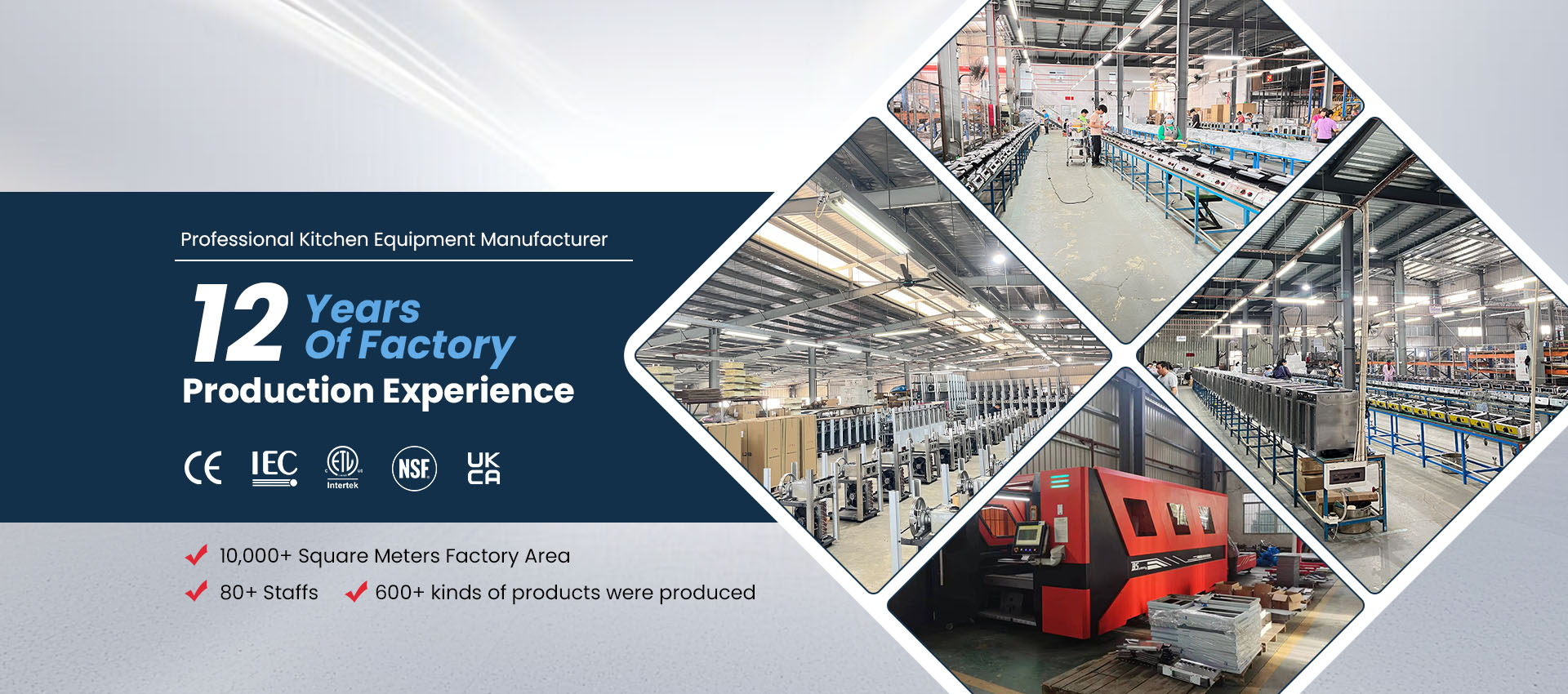
As a commercial kitchen equipment manufacturer, we integrate product development, manufacturing and quality inspection to support different market requirements. Our production capability allows us to provide restaurant equipment solutions with stable supply and customized options.
Understand The OEM And ODM Process
OEM and ODM services are becoming increasingly important for companies developing their own product lines. A reliable commercial kitchen equipment supplier should have a clear customization process.
A typical OEM / ODM workflow includes:
Requirement analysis and product discussion
Technical confirmation and design adjustment
Prototype development and testing
Mass production preparation
Quality inspection and shipment
Customization may include product appearance, functions, electrical specifications, logo placement and packaging requirements. This flexibility helps customers develop products suitable for different regional markets.
Check Materials And Manufacturing Standards
Material quality directly affects equipment durability, hygiene performance and service life. Stainless steel is widely used in commercial kitchen equipment because of its corrosion resistance, easy cleaning properties and suitability for food contact environments.
The U.S. Food and Drug Administration highlights stainless steel as a commonly used material for food equipment due to its hygienic characteristics and resistance to corrosion.
During manufacturing, important checkpoints include:
Stainless steel grade and thickness verification
Welding quality inspection
Surface finishing inspection
Component fitting accuracy
Electrical safety testing
For products such as commercial griddles, fryers and cooking equipment, stable heating performance and structural durability are essential for continuous restaurant operation.
For example, our commercial griddle solutions are designed with durable structures and stable heating systems to meet different foodservice applications: https://www.mlpkitchen.com/product-category/cooking-equipment/
Consider Bulk Supply And Project Delivery Capability
Large restaurant projects require more than individual products. They need reliable production schedules, packaging solutions and shipment coordination.
Before placing bulk orders, key questions should be considered:
Can the supplier maintain consistent quality during mass production?
Does the factory have enough production capacity?
Are spare parts and after-sales support available?
Can packaging meet international transportation requirements?
A professional manufacturing partner should have standardized production processes to reduce risks during large-volume supply.
Quality Control And Export Compliance
Quality control is essential throughout the manufacturing process. Effective inspection should not only happen before shipment but also during different production stages.
A complete quality control system usually includes:
Incoming material inspection
Production process monitoring
Function testing
Safety inspection
Final appearance checking
Packing verification
For international markets, commercial kitchen equipment may also need to meet specific electrical and safety requirements depending on the destination country. Understanding export market compliance helps prevent delivery delays and installation issues.
Choosing A Reliable Equipment Partner
The right commercial kitchen equipment selection requires a balance between product performance, manufacturing capability and long-term supply reliability. A factory with strong OEM / ODM experience, complete production management and strict quality control can provide more stable support for restaurant projects.
With professional manufacturing experience, we focus on developing commercial kitchen equipment solutions including cooking equipment, Snack Equipment and foodservice products. From product design and production control to inspection and export preparation, we help customers build efficient and reliable kitchen solutions for global markets.