


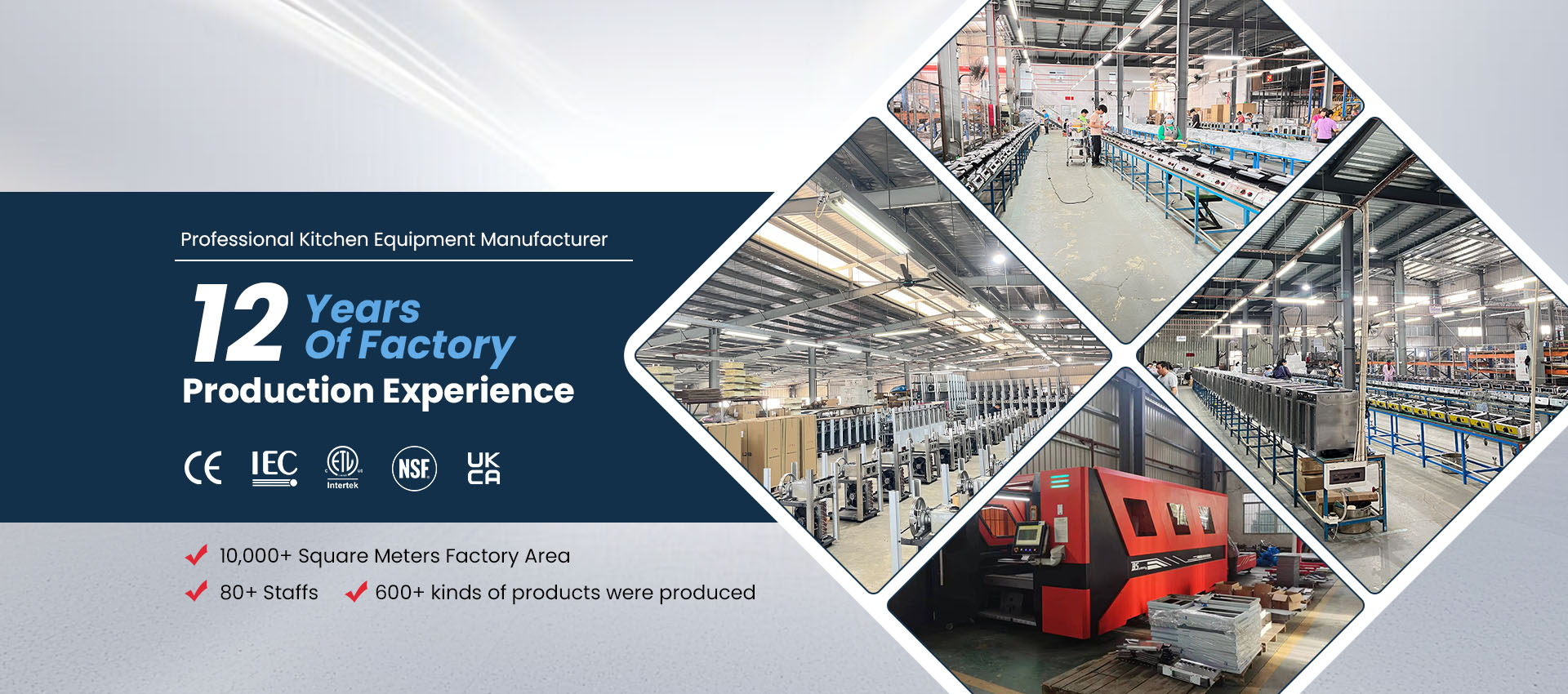
How Manufacturers Control Quality During Commercial Kitchen Equipment Production
Quality control is the foundation of reliable commercial kitchen equipment. Unlike household appliances, commercial kitchen products are designed for continuous operation, frequent cleaning, high-temperature environments, and demanding working conditions. A professional manufacturer must control every stage from material selection and component processing to final testing and shipment.
The global foodservice equipment industry continues to focus on durability, hygiene, and safety compliance. Stainless steel remains one of the most widely used materials in commercial kitchen equipment because of its corrosion resistance, easy cleaning characteristics, and long service life.
For manufacturers, quality is not only about checking finished products. It requires a complete production management system covering material standards, manufacturing processes, inspection procedures, and export requirements.
DINGFENG focuses on commercial kitchen equipment manufacturing with strict quality management throughout product development, production, and delivery to ensure stable performance for professional kitchen applications.
1. Material Selection: The First Quality Control Step
The quality of commercial kitchen equipment starts with raw materials.
Professional manufacturers carefully select materials according to application requirements, especially for food-contact areas and high-moisture environments.
Common materials include:
| Material | Application | Key Advantages |
|---|---|---|
| 304 Stainless Steel | Worktables, sinks, preparation equipment | Corrosion resistance and hygiene |
| 316 Stainless Steel | Special environments requiring higher corrosion resistance | Strong chemical resistance |
| Aluminum Components | Lightweight structures and accessories | Low weight and good processing performance |
Stainless steel is widely used in commercial kitchens because it provides durability, cleanability, and resistance to demanding operating conditions.
During incoming material inspection, manufacturers check:
Material grade
Thickness accuracy
Surface condition
Supplier documentation
Chemical composition
This prevents inconsistent materials from entering production.
2. Manufacturing Process Control
Commercial kitchen equipment requires precision during fabrication. Small differences in welding, cutting, or assembly can affect product durability and appearance.
A complete manufacturing process usually includes:
Material cutting
Sheet metal forming
Welding and polishing
Component assembly
Surface treatment
Functional testing
Final inspection
Each production stage requires specific quality checkpoints.
| Production Stage | Quality Control Focus |
|---|---|
| Cutting | Size accuracy and edge quality |
| Forming | Shape consistency |
| Welding | Strength and appearance |
| Polishing | Smooth surface finish |
| Assembly | Component alignment |
| Testing | Product performance |
A professional factory uses standardized processes to maintain consistency during bulk production.
3. Welding Quality Inspection
Welding is one of the most important processes in stainless steel commercial kitchen equipment.
Poor welding quality may cause:
Weak joints
Water leakage
Surface defects
Reduced service life
Manufacturers control welding quality through:
Skilled welding operation
Welding parameter management
Joint inspection
Surface polishing checks
For kitchen equipment, smooth welded surfaces are especially important because they reduce dirt accumulation and improve cleaning efficiency.
4. Surface Treatment And Hygiene Control
Commercial kitchens require equipment that can withstand frequent cleaning and sanitation.
Quality control focuses on:
Surface smoothness
Polishing consistency
Corrosion resistance
Easy-clean design
Stainless steel is preferred in foodservice environments because its non-porous surface helps support hygiene requirements and repeated cleaning operations.
Manufacturers evaluate:
| Inspection Item | Purpose |
|---|---|
| Surface finish | Ensure appearance quality |
| Welding marks | Improve product durability |
| Sharp edges | Prevent safety risks |
| Rust resistance | Maintain long-term performance |
5. Equipment Function Testing
Before shipment, commercial kitchen equipment should pass complete functional testing.
Depending on the product type, testing may include:
Electrical safety testing
Heating performance testing
Temperature control testing
Water leakage testing
Operation stability testing
For powered commercial food equipment, standards such as NSF/ANSI 8 define requirements related to materials, design, construction, and performance.
A reliable manufacturer verifies that products perform correctly before reaching the market.
6. OEM And ODM Quality Management
Customized commercial kitchen equipment requires stronger quality control because every project may have different specifications.
A professional OEM/ODM process usually includes:
Product Design Review
Engineers evaluate:
Product structure
Material selection
Manufacturing feasibility
Safety requirements
Prototype Verification
Sample units are tested for:
Function performance
Assembly accuracy
Appearance quality
Mass Production Control
After approval, manufacturers maintain:
Standard production procedures
Consistent materials
Regular inspection points
Production records
This ensures that large-volume orders maintain the same quality as approved samples.
7. Quality Control For Bulk Production
Large commercial kitchen projects require stable production capability.
Before choosing a manufacturer, evaluate:
| Factor | Quality Consideration |
|---|---|
| Production capacity | Can the factory handle required volume? |
| Process control | Are manufacturing procedures standardized? |
| Inspection system | Are quality checks documented? |
| Material management | Are materials traceable? |
| Delivery control | Are production schedules reliable? |
A factory with complete quality management can reduce risks related to inconsistent products and delayed delivery.
8. export market compliance
Commercial kitchen equipment is often supplied to international markets, which requires attention to different regulations and documentation.
Professional manufacturers prepare:
Product specifications
Material certificates
Inspection reports
Packaging standards
Shipping documents
Export experience helps manufacturers understand requirements related to:
Product labeling
Safety standards
Customer documentation
Regional compliance
9. Manufacturer Vs Trader: Why Production Control Matters
When sourcing commercial kitchen equipment, working with a manufacturer provides stronger quality control advantages.
A direct manufacturer can manage:
Material selection
Production processes
Quality inspections
Product improvements
Custom development
A trader mainly coordinates supply, while a manufacturer controls the actual production process and can directly solve technical issues.
10. Commercial Kitchen Equipment Quality Checklist
Before selecting a supplier, consider:
Are food-grade materials used?
Does the factory control the complete production process?
Are welding and polishing standards established?
Are products tested before shipment?
Can the manufacturer support OEM and ODM projects?
Are quality records available?
Does the supplier understand export requirements?
Why Choose DINGFENG For Commercial Kitchen Equipment Manufacturing
Reliable commercial kitchen equipment requires more than production capacity. It requires strict quality management, manufacturing experience, and continuous process improvement.
DINGFENG provides:
Professional commercial kitchen equipment manufacturing
Customized OEM and ODM solutions
Strict material control
Complete production inspection
Stable bulk production capability
Export project support
By controlling every step from raw material inspection to final testing, DINGFENG helps deliver durable, hygienic, and reliable kitchen equipment solutions for professional foodservice environments.