


Why Factory Inspection Matters When Purchasing Kitchen Equipment
Purchasing commercial kitchen equipment is a long-term investment that directly affects kitchen efficiency, maintenance costs, and daily operations. However, product appearance and specifications alone cannot fully represent equipment quality. A professional factory inspection is essential to verify whether the equipment meets manufacturing standards, performance requirements, and project expectations before shipment.
commercial kitchen equipment operates in demanding environments with continuous heating, moisture exposure, frequent cleaning, and intensive workloads. According to NSF food equipment standards, commercial food equipment quality evaluation involves materials, design, construction, sanitation, and product performance. These standards cover equipment categories such as cooking equipment, fryers, griddles, ovens, and hot food holding equipment.
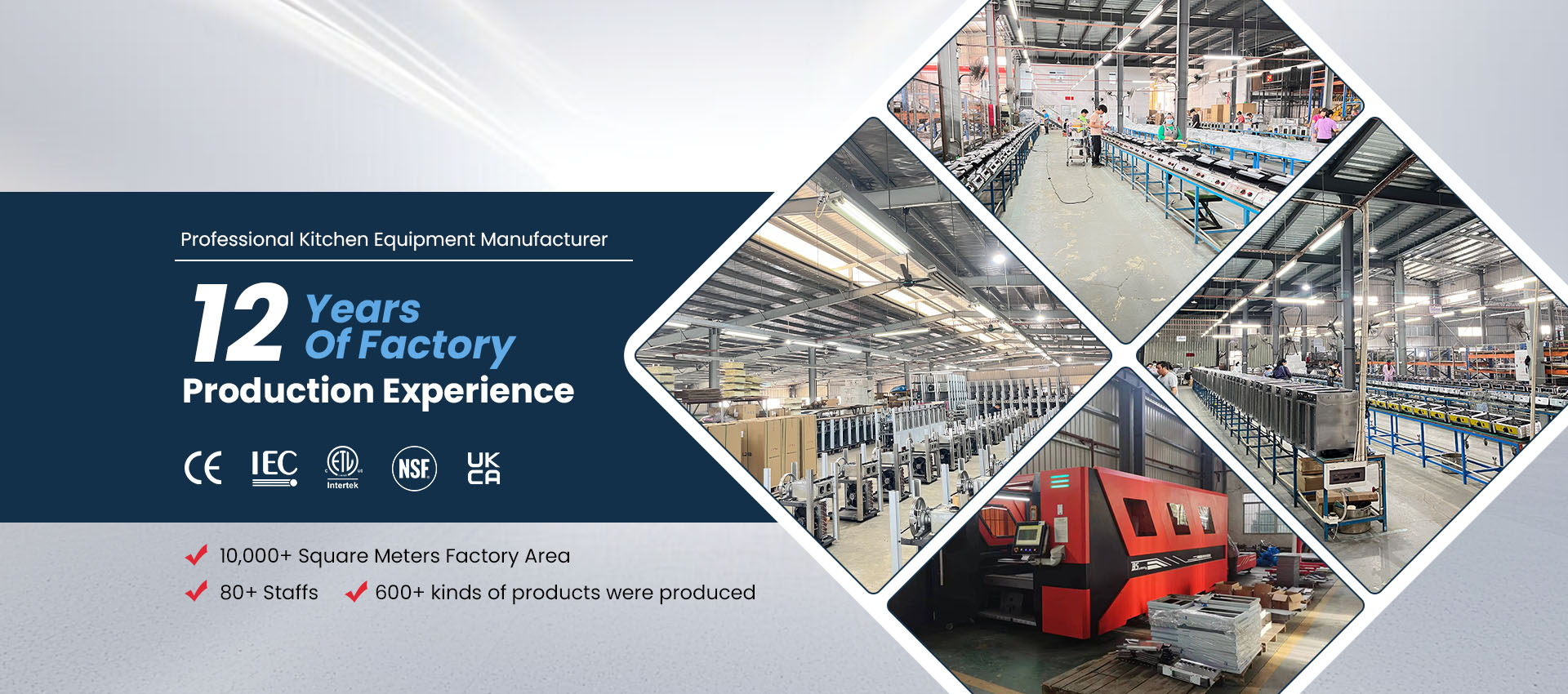
As an experienced commercial kitchen equipment manufacturer, DINGFENG integrates factory inspection into every stage of production. Through strict quality control, material verification, performance testing, and shipment checks, DINGFENG helps ensure that commercial kitchen equipment delivers stable performance after installation.
Factory Inspection Shows The Real Manufacturing Capability
One important reason to conduct factory inspection is to understand whether a supplier truly controls its manufacturing process.
There is a significant difference between a manufacturer and a trader. A trader may coordinate products from different sources, while a factory manufacturer directly manages:
Product development
Material selection
Production processes
Quality control
Final testing
When purchasing from a professional restaurant equipment manufacturer, factory inspection allows you to evaluate production capability instead of only reviewing product photos or catalogs.
A reliable factory should demonstrate:
| Inspection Area | Evaluation Purpose |
|---|---|
| Production Facility | Confirm actual manufacturing capability |
| Processing Equipment | Check fabrication ability |
| Production Flow | Understand quality management |
| Testing Equipment | Verify performance inspection |
| Warehouse Management | Evaluate delivery preparation |
DINGFENG manages production internally, covering equipment fabrication, assembly, testing, and quality inspection to maintain consistent product standards.
Verify Material Standards Before Production
Material quality directly influences the lifespan and reliability of commercial kitchen equipment.
During factory inspection, important material checks include:
Stainless steel grade
Material thickness
Surface finishing quality
Component durability
Food-contact material compliance
NSF/ANSI food equipment material standards focus on ensuring that materials used in commercial food equipment are suitable for food environments and designed to maintain safety and cleanability.
A professional commercial kitchen equipment manufacturer should clearly explain material selection and manufacturing standards.
For equipment such as griddles, fryers, and cooking ranges, high-quality materials help improve:
Corrosion resistance
Cleaning efficiency
Structural strength
Service life
DINGFENG applies strict material inspection procedures before production to ensure equipment meets commercial application requirements.
Check The Manufacturing Process Overview
Factory inspection provides a clear view of how equipment is actually produced.
A complete manufacturing process usually includes:
| Manufacturing Stage | Inspection Focus |
|---|---|
| Raw Material Inspection | Confirm incoming material quality |
| Cutting Process | Verify dimensional accuracy |
| Welding Process | Check structural strength |
| Surface Treatment | Ensure finishing quality |
| Assembly Process | Confirm component installation |
| Performance Testing | Verify operating functions |
A factory with standardized production procedures can better control product consistency.
Compared with suppliers that rely on external production, manufacturers with internal production management can respond faster when technical adjustments or customization requirements appear.
DINGFENG follows structured manufacturing procedures from raw materials to finished equipment, supporting stable production quality for different commercial kitchen applications.
Quality Control Checkpoints Reduce Future Problems
Factory inspection is not only about checking finished products. Professional manufacturers establish quality checkpoints throughout the entire production process.
Important checkpoints include:
Incoming Material Inspection
Before manufacturing begins, materials and components are checked according to production requirements.
Production Process Inspection
Technicians monitor:
Welding quality
Assembly accuracy
Structural stability
Component installation
Functional Testing
Finished equipment is tested for:
Heating performance
Temperature control
Electrical safety
Operating stability
Final Shipment Inspection
Before delivery, factories verify:
Product appearance
Accessories
Packaging
Documentation
NSF notes that commercial food equipment evaluation includes material safety, hygienic design, construction, and performance verification, highlighting the importance of systematic quality management during manufacturing. (NSF)
Confirm OEM And ODM Production Ability
Factory inspection is especially important for customized projects because OEM and ODM products require stronger engineering and production capabilities.
Before cooperation, inspection should confirm whether the manufacturer can support:
Custom dimensions
Functional modifications
Brand customization
Packaging requirements
Market-specific specifications
A professional OEM commercial kitchen equipment manufacturer should have a complete process:
Requirement analysis
Engineering evaluation
Sample development
Testing confirmation
Mass production
Final inspection
DINGFENG supports customized commercial kitchen equipment solutions by combining engineering experience with factory production capabilities.
Evaluate Bulk Supply Capability
For large restaurant projects and distribution requirements, factory inspection can help evaluate whether the supplier has enough production capacity.
Important evaluation points include:
| Capability | Why It Matters |
|---|---|
| Production Capacity | Supports stable delivery schedules |
| Standardized Processes | Maintains product consistency |
| Quality System | Reduces batch differences |
| Inventory Management | Improves supply reliability |
| Packaging Capability | Protects products during shipping |
A reliable bulk supply commercial kitchen equipment supplier should have the ability to produce consistent products over repeated orders.
DINGFENG maintains standardized production management to support different project scales while ensuring product quality remains stable.
Review Export Market Compliance Capability
International kitchen equipment projects require attention to different market requirements.
Factory inspection should include:
Certification capability
Electrical specification management
Export documentation
Packaging standards
Shipping preparation
A manufacturer with export experience understands that product quality is not only about production but also about meeting destination market requirements.
NSF certification programs emphasize that commercial food equipment evaluation includes testing and auditing related to product safety, materials, design, and manufacturing practices.
DINGFENG focuses on international market requirements and provides commercial kitchen equipment solutions supported by professional manufacturing management.
Project Sourcing Checklist Before Purchasing
Before confirming a supplier, a factory inspection checklist can help evaluate manufacturing reliability.
| Evaluation Category | Key Questions |
|---|---|
| Factory Ownership | Does the supplier control production internally? |
| Manufacturing Process | Are production steps standardized? |
| Material Standards | Are commercial-grade materials used? |
| Quality Control | Are inspection records available? |
| Customization | Can OEM and ODM projects be supported? |
| Export Ability | Can international requirements be handled? |
A detailed inspection process helps identify whether a supplier has real manufacturing capability.
Factory Inspection Builds Long-Term Equipment Confidence
Factory inspection provides valuable information that cannot be obtained from product descriptions alone. It shows how equipment is designed, manufactured, tested, and prepared for shipment.
Choosing a professional foodservice equipment manufacturer means gaining stronger quality control, better customization support, and more reliable supply capability.
With factory-controlled production processes, OEM and ODM experience, strict quality inspection procedures, and a complete commercial kitchen equipment product range, DINGFENG continues to provide dependable solutions for restaurants, catering projects, and foodservice applications worldwide.